How to Report Stagnant Water and Mosquito Breeding to the Civic Authorities in Bangalore
There is a puddle on the plot next to your building that has been there since the last rain. The stormwater drain at the end of your road is blocked and the water in it has turned green. A construction site nearby has a basement full of water and a cloud of mosquitoes rising from it at dusk. You have cleaned your own balcony, emptied every pot and flower tray and fitted nets on your windows, and still the mosquitoes keep coming, because the source is not in your home. Most people in this situation know they should complain, but they are not sure to whom, how, with what evidence and what to do when nothing happens.
This guide explains how to report stagnant water and mosquito breeding in Bangalore in a way that gets noticed: how to recognise a genuine breeding site, how to collect useful evidence safely, how to decide who is responsible, which kinds of channels exist, how to write a clear complaint, how to follow up and escalate, how to involve your neighbours and residents' association and how to protect your own household while you wait. It also explains what not to do, including the common mistakes that make complaints easy to ignore. Civic structures and helpline details change over time, so check the current names and contact channels before you use them.
The short answer: document it, report it to the right body through an official channel and keep following up
Take clear photos or a short video of the stagnant water with the date, time and exact location, preferably from a safe distance on public ground. Work out whether the site is a public space such as a road, drain, park, lake edge or vacant government land, or private property such as a plot, construction site or neighbouring building. Report public sites to the civic authority for your ward through its official app, helpline, website or ward office, and report private breeding sites to the same authority and, where relevant, to the health department and the property's owner or association. Keep the complaint reference number, follow up politely at set intervals, escalate to a senior officer if nothing happens and involve your residents' association so the complaint carries more weight. Meanwhile, protect your own household with source reduction, screens and personal protection.
A note on civic bodies and contact details
Bengaluru's civic administration has been reorganised in recent years, so the name of the authority that handles your ward may differ from what older articles, notice boards and websites say. You may still see the former name in notices, apps and old documents. Before you complain, check the current authority and the zone or ward that covers your address, using the official government website or the signboards in your area, and use only official apps, helplines and email addresses. Water supply leaks and sewage overflows are usually handled by the water supply and sewerage board, and disease-related complaints may also go to the health department. If you are unsure, start with your ward office or health officer, who can direct you to the right desk.
Why reporting matters
- Public health: Aedes mosquitoes can spread dengue and chikungunya, Anopheles can spread malaria and Culex can cause severe nuisance and, in some regions, other diseases. A single neglected breeding site can supply mosquitoes to many homes.
- Breeding is fast: In warm weather, mosquitoes can develop from egg to adult in roughly seven to ten days, so a puddle that survives a week or two is a real producer.
- Individual effort is not enough: You cannot fix a blocked public drain, a flooded construction pit or a neighbour's neglected water tank by cleaning your own home.
- Authorities can act where residents cannot: Civic and health bodies can inspect sites, order owners to remove standing water, clear drains, carry out larval control and, where rules allow, take enforcement action.
- Reports create a record: A trail of dated complaints helps if cases occur in your area and for any later follow-up.
What counts as a mosquito breeding site
Almost any still water that lasts more than a few days can host mosquito larvae. Typical sites include:
- Blocked or slow drains and stormwater channels with water sitting between rains.
- Construction sites with flooded basements, pits, foundations, uncovered tanks, drums, tyres and stored materials that collect water.
- Vacant plots and wasteland with puddles, dumped containers, tyres and rubbish.
- Potholes and road depressions that stay full after rain.
- Overhead tanks, sumps and cisterns with open or broken lids.
- Neglected lakes, lake edges and canals with weed, rubbish and stagnant corners.
- Discarded tyres, containers, coconut shells and plastic dumped on roadsides and plots.
- Leaking pipes and overflowing sewage forming pools.
- Flooded basements and parking areas in buildings.
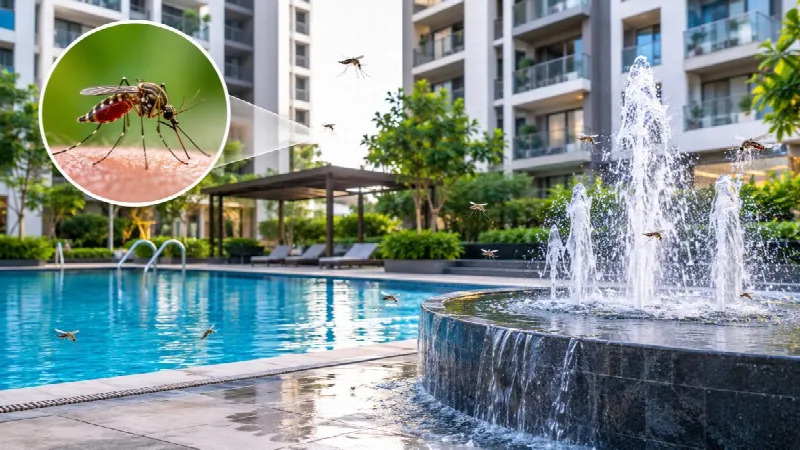
- Ornamental ponds, fountains and pools that are not maintained.
How to confirm it is a breeding site
- Look for larvae (wrigglers): Tiny, thin, wriggling specks hanging at the water surface that dart downward when you move. Pupae look like small commas.
- Check how long the water has been there: Water that remains for more than a week is more likely to be a breeding site.
- Notice adult mosquitoes: A cloud of mosquitoes rising from vegetation or a drain when disturbed, or heavy biting in one spot at certain times of day.
- Observe the water: Still, shaded, green or debris-filled water is more attractive, but even clean water in a container can breed Aedes.
You do not need to be certain before reporting. A clear description of stagnant water that has stayed for days and a record of mosquito activity are enough for officials to inspect.
Collecting evidence safely
- Stay safe: Photograph from public ground and a safe distance. Do not climb into pits, enter construction sites, cross fences, wade into water or approach deep or fast-moving water. Avoid busy roads without taking care.
- Take wide and close photos: A wide shot showing the surroundings, nearby buildings and landmarks, and a close-up of the water and any larvae, if visible.
- Record a short video: A 10 to 20 second video pans across the site and shows the scale of the problem.
- Capture the location: Note the street name, nearest building, landmark, ward number if you know it and your phone's location pin. Many complaint apps will take the location from your photo or phone.
- Note the date and time: Include several dates if the water persists, so the complaint shows how long the problem has lasted.
- Describe the impact: Mention bites, fever cases in the area, nearby schools, hospitals, anganwadis or elderly residents, which help officials prioritise.
- Do not photograph people without need: Focus on the water and the site, and respect privacy.
Who is responsible: public land or private property
- Public roads, drains, footpaths, parks and public water bodies: The civic body for your ward handles maintenance and complaints. Report through its official channels.
- Government or institutional land: Complain to the civic body and, where relevant, to the department or institution that owns the land.
- Private plots and construction sites: The owner or builder is responsible for keeping the site free of stagnant water. Report to the civic body and the health department, which can inspect and issue notices, and, if you know the builder, to the project office.
- Apartment buildings, basements and common areas: The residents' association or management company is responsible. Raise it with them in writing first.
- Water supply and sewage leaks: Report to the water supply and sewerage board through its helpline or app.
- Neighbouring houses: Speak politely to the neighbour first if you can. If that fails, involve the association or the civic health officer.
Channels you can use
Options vary and change over time, so confirm what is currently active for your area.
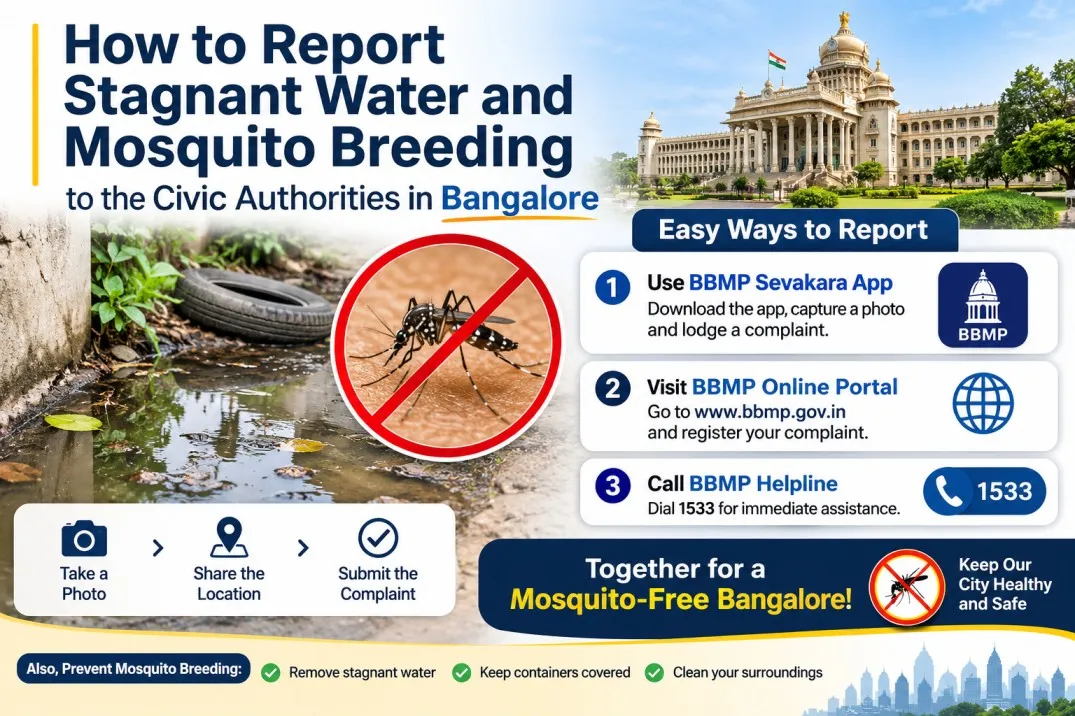
- Official civic grievance app or portal: The fastest route in most cases. You can upload photos, tag the location and receive a ticket number.
- Official helpline numbers: Useful when you need to speak to someone, and they usually generate a complaint number.
- Ward office or zonal office: You can visit or call and speak to the health officer, engineer or inspector for your ward.
- Health department: For stagnant water linked to mosquito breeding and fever cases, the health officer for your area can inspect and arrange larval control.
- Official email addresses and web forms: Good for detailed complaints with attachments.
- Social media tagging of official handles: Sometimes brings attention quickly, but treat it as a supplement, not a replacement, for a registered complaint.
- Resident welfare association or apartment federation: Can lodge a collective complaint and meet officials.
- Local elected representatives: A last resort if a serious issue is not addressed through normal channels.
How to write a clear complaint
A good complaint is short, specific and factual. Include the following:
- Who you are: Name, phone number and address, or the details required by the portal.
- Where it is: Exact address or landmark, ward or area name and a map pin.
- What it is: Stagnant water in a drain, a flooded construction pit, a plot with standing water and so on.
- How long it has been there: Dates you have seen it, and how often it recurs.
- Why it matters: Mosquito breeding, bites, nearby school or hospital, cases of fever in the neighbourhood.
- What you want: Inspection, draining, larval treatment, drain cleaning, notice to the owner.
- Attachments: Photos and a short video with the date.
Sample wording: "Respected Sir/Madam, there has been stagnant water at [exact location, landmark, ward/area] since [date]. I photographed it on [dates]. Mosquito larvae are visible and residents in [street/building] are being bitten daily, including children and elderly people. The site is near [school/hospital/park]. I request an inspection and urgent action to drain or treat the water and to prevent mosquito breeding. Photos are attached. My contact number is [number]. Please share the complaint number and the action taken."
Following up and escalating
- Save the complaint number and a screenshot of the submission.
- Wait a reasonable period, such as three to five working days, unless the situation is urgent, then check the status through the app or helpline.
- Send a polite reminder quoting the complaint number, the date of the original report and new photos if the problem persists.
- Escalate to the next level: The ward officer, zonal officer or health officer, using official contact details, and mention the earlier complaint number.
- Involve your residents' association: A joint letter from the association, with photos and signatures, is harder to ignore.
- Report related health concerns: If there is fever in the neighbourhood, inform the local health officer so that surveillance and control measures can be considered.
- Keep a log: Record dates, ticket numbers, names and responses. This helps if you need to escalate further.
- Acknowledge action when it happens: A thank-you and updated photos encourage responsiveness, and tell the authority if the problem returns.
What not to do
- Do not trespass or enter hazardous sites to take photos. Your safety matters more than the evidence.
- Do not pour oil, kerosene, chemicals or pesticides into public water or drains. This can harm wildlife and water quality and may be unlawful. Larval control should be done by trained staff using approved products.
- Do not release fish or other animals into drains, lakes or ponds without expert approval.
- Do not confront or threaten owners, workers or officials. Keep communication polite and in writing.
- Do not post unverified accusations on social media. State facts, tag official channels and avoid personal attacks.
- Do not file duplicate complaints repeatedly. Follow up on the existing ticket and escalate rather than opening many new ones for the same site.
- Do not rely only on fogging requests. Fogging gives short-lived relief for adult mosquitoes, but removing the breeding site and treating larvae are what solve the problem.
Working with neighbours and your residents' association
- Compile a joint complaint with photos and the names of affected households, and submit it through the association.
- Nominate a point person to follow up so that officials deal with one contact.
- Organise a weekly inspection of your own premises, including terraces, basements, tanks, planters and garbage areas.
- Encourage a regular "dry day" when every household empties and dries containers, a practice often promoted by health authorities during mosquito season.
- Invite the ward health officer to inspect and advise during outbreaks or heavy mosquito seasons.
- Check for breeding in your own backyard first. A community complaint is stronger when your own site is clean.
Protecting your household while you wait
- Remove water from your own premises: Empty buckets, plant saucers, tyres, coolers and trays every week, and cover tanks and drums.
- Fit fine mesh screens on windows, doors and ventilators and repair gaps.
- Use repellents suitable for your family, and ask a doctor or pharmacist about products for children, pregnant women and people with skin conditions.
- Wear long sleeves and light clothing at dawn and dusk, and for Aedes during the day as well.
- Seek medical care promptly for fever, severe body ache, headache, rash, vomiting or other worrying symptoms, and do not self-medicate.
- Consider professional mosquito control for your premises, including larval control in sumps and tanks and targeted treatment of resting areas, but remember that it does not replace removing the public breeding site.
Bangalore-specific factors
Bangalore's monsoon season, roughly June to September, and the showers that continue into the cooler months fill drains, pits, plots and containers repeatedly, and breeding can occur in any of them. Rapid construction across the city leaves many basements, foundation pits and storage areas holding water for weeks, and road works, drain repairs and utility digging create temporary pools that are easy to forget. Lakes, storm drains and the network of raja kaluves (primary and secondary stormwater drains) run through residential areas, and blockages or accumulated waste turn sections of them into long, slow-moving breeding channels.
The city's density means that a single neglected site can affect several apartment communities and streets. That is why a joint complaint from neighbouring associations is powerful. Also be aware that a few days of heavy rain can wash away larvae, but the pools that remain after the rain are exactly where new generations develop, so the days after rain are the best time to check and report.
Myths about stagnant water and mosquitoes
- "It is only dirty water that breeds mosquitoes." Aedes and Anopheles often breed in clean water, so a clear puddle or a clean tank can still be a breeding site.
- "If the water is moving a little, it is fine." Slow or intermittent flow with still edges and pockets can still breed mosquitoes.
- "Complaints do not work." Documented, specific complaints followed up politely, ideally through associations, do get results, though it may take persistence.
- "Fogging will solve everything." Fogging does not kill larvae, and mosquitoes return unless breeding is stopped.
- "Pouring oil on the water is a harmless fix." It can harm the environment and is not an approved method for public water bodies.
- "It is not my job to report." Public health depends on residents noticing and reporting problems that officials cannot see everywhere.
Common mistakes to avoid
- Reporting without a clear location or photos.
- Describing the problem in general terms such as "mosquito problem" without naming the actual site.
- Complaining only by phone with no complaint number.
- Filing the complaint with the wrong body, such as a supply board for a blocked drain.
- Not following up or escalating after a reasonable time.
- Ignoring your own premises while complaining about others.
- Entering unsafe sites for photos.
- Using chemicals or oil in public water yourself.
- Giving up after the first attempt.
Mosquitoes still biting after you have cleaned your own home? iPest's mosquito control service in Bangalore inspects your premises for hidden breeding sites, treats tanks, sumps and drains with approved methods and advises on the evidence to collect when the source is outside your property. Book an inspection today.
Frequently asked questions
Who do I complain to about stagnant water near my home in Bangalore?
For public roads, drains and public land, report to the civic authority for your ward through its official app, helpline, website or ward office. For private plots, construction sites and buildings, report to the same authority and the health department, and also inform the owner, builder or residents' association where possible. Water supply and sewage leaks may go to the water supply and sewerage board. Check the current names and contact details before you use them.
What evidence should I include in my complaint?
Include clear photos and a short video with dates, the exact location and landmark, how long the water has been there, any larvae or mosquito activity you can see, and the impact on residents. Take photos from a safe public vantage point and do not enter private or hazardous areas.
How long should I wait before following up?
For a routine problem, wait around three to five working days and then check the status using your complaint number. For a serious or fast-growing problem, such as flooding near a school or a cluster of fever cases, follow up sooner and mention the urgency. Escalate to a senior officer if there is no response.
Can I treat the stagnant water myself?
Not in public drains or water bodies. Pouring oil or chemicals can harm the environment and may be unlawful. You can remove water from containers on your own property, cover tanks and improve drainage. For public sites, ask the civic or health authority to arrange draining, clearing or approved larval treatment.
Does fogging stop mosquito breeding?
No. Fogging kills some adult mosquitoes for a short time, but larvae in the water are not affected and new adults emerge within days. Draining, clearing and treating breeding sites, along with repeated inspections, is what reduces mosquitoes over time.
What should I do if people in my area have fever?
Anyone with fever, severe body ache, headache, rash, vomiting or other concerning symptoms should see a doctor promptly and mention mosquito exposure. Residents should also inform the local health officer or the association about clusters of cases so that inspection and control measures can be considered. Do not self-medicate.
This guide is part of iPest's complete resource on mosquito control. To find and eliminate the source, see our guides on mosquitoes around apartment pools, fountains and water features, why mosquitoes multiply faster in Bangalore's monsoon and our full mosquito control guide for Bangalore.
Health note: This article provides general information and cannot diagnose any individual. If you or a family member has fever, rash, severe body ache or other symptoms after mosquito exposure, please consult a doctor.
Need Mosquito Control in Bangalore?
Wall-to-wall residual spray mosquito treatment for Bangalore homes — effective up to 15 days, no need to vacate, CIB&RC-registered and safe for kids & pets.
Near you: Pest control in Kumaraswamy Layout · Pest control in Indiranagar
Book Pest Inspection
Our team will contact you within 30 minutes
Thank you! We'll call you shortly.
For urgent help, call +91 7411032320