
Why Cockroaches Keep Returning in Bangalore Apartments Even After Cleaning
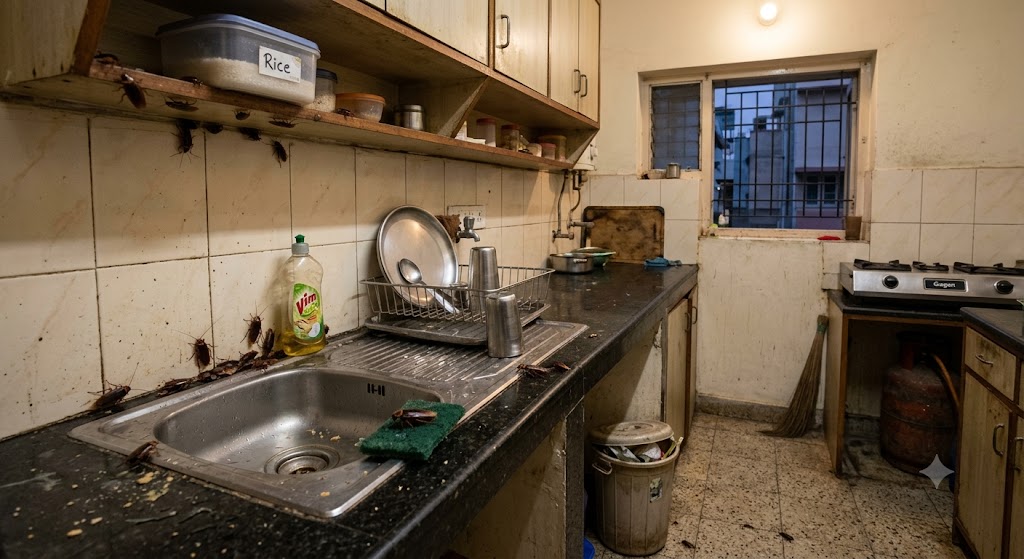
Why Do Cockroaches Keep Coming Back After You Clean? (Bangalore Apartment Guide)
You scrub the kitchen, empty the bins, wipe down every shelf — and within a week, the cockroaches are back skittering across the counter at midnight. It feels like the cleaning did nothing. In a way, it didn't: cleaning removes what cockroaches eat, but almost none of the reasons they came in the first place.
If you live in a Bangalore apartment, you're also fighting a few things a standalone house owner isn't — shared plumbing, common drainage, humid weather, and neighbours whose kitchens you can't clean. This guide breaks down exactly why the roaches keep coming back after every cleaning, and what actually breaks the cycle.
The short answer
Cockroaches keep returning after cleaning because cleaning only removes surface food, not the three things that sustain an infestation: hidden egg cases (oothecae) that survive scrubbing and hatch weeks later, moisture and harborage inside walls, drains and cabinets you can't reach, and a constant supply of new roaches migrating in from neighbouring flats through shared plumbing and drainage. Until those are addressed, a clean apartment is simply a tidier home for the same cockroaches.
That's the core of it. The rest of this article explains each reason, why Bangalore makes it worse, and how to stop the return for good.
Why Bangalore apartments are cockroach magnets
Bangalore's climate is close to ideal for cockroaches almost year-round. They thrive in warm, humid conditions with easy access to water, and the city rarely gets cold enough or dry enough to slow them down. During the monsoon months from June to September, rising indoor humidity and waterlogged common areas push activity higher still.
Apartment living compounds the problem in ways that don't affect independent houses:
- Shared plumbing stacks. High-rises run common vertical pipes and drainage risers behind kitchens and bathrooms. Cockroaches — especially the German species — travel between floors and flats through these voids, gaps around pipes, and wet wall cavities.
- Common drainage and garbage points. Shared chutes, wet garbage collection areas, basement sumps and clogged floor drains act as breeding reservoirs. Even a spotless flat draws roaches from these communal sources.
- Water everywhere. Overhead tanks, underground sumps, RO drip trays, and perpetually damp utility-area corners give roaches the moisture they need to survive, even when food is scarce.
- Density. In a building with dozens of units, you're never treating an isolated space. You share walls, ceilings and pipes with every other kitchen in the block.
This is why so many residents feel their cleaning "never works." The problem was never confined to their four walls.
The two cockroaches you're actually dealing with
Not all cockroaches behave the same way, and the treatment that works on one barely touches the other. In Bangalore apartments, you're almost always dealing with one or both of these.
German cockroaches — the ones that never leave
Small, light brown, with two dark stripes running down the shield behind the head, German cockroaches are the classic kitchen infestation. They live indoors permanently, cluster inside warm humid harborage near food and water — behind the fridge, under the sink, inside cabinet hinges, around the gas stove and inside small appliances — and breed astonishingly fast. A single female and her offspring can produce hundreds of new roaches in a few months.
This is the species behind most "they keep coming back" complaints. They rarely leave the building on their own, and they're the hardest to eliminate.
American cockroaches — the ones that crawl up the drain
Large, reddish-brown and fast, American cockroaches are the big ones you see darting across the bathroom floor at night. They don't usually breed inside your flat in the same numbers; instead they live in drains, sewers, sumps, basements and wet common areas, and travel up through the plumbing into your bathrooms and kitchen at night.
If your "infestation" is mostly big roaches appearing near floor drains and pipes, your problem is largely outside your flat — in the building's drainage — and no amount of kitchen cleaning will fix it.
Knowing which one you have matters, because the fix is different: German cockroaches need targeted baiting inside harborage, while American cockroaches need drain and entry-point treatment.
Reason 1: The egg cases survive your cleaning
This is the single biggest reason roaches "come back."
Cockroaches don't lay individual eggs — they produce a hardened, protective capsule called an ootheca, each holding roughly 30 to 40 eggs. The female tucks these capsules into tight, hidden crevices: cabinet corners, the seams of appliances, behind skirting, inside hinge gaps. The ootheca's tough casing shrugs off ordinary wiping, mopping and even most surface sprays.
So here's what actually happens when you clean:
- You wipe out the visible adults and the food.
- The egg cases, hidden and protected, are untouched.
- Days to a few weeks later, they hatch — dozens of young roaches per capsule.
- It looks like the infestation "came back," when really it never left.
Any approach that doesn't specifically deal with the next generation of eggs is doomed to this cycle. This is exactly why professional treatment uses insect growth regulators (more on that below) — they break the breeding cycle rather than just killing what's currently visible.
Reason 2: Your neighbours' flats are the real reservoir
You can keep your own kitchen immaculate and still lose the battle, because in an apartment you don't control the whole environment.
German cockroaches move between units through the smallest openings — gaps around water and gas pipes, shared wall cavities, electrical conduits, and the plumbing risers that connect stacked kitchens and bathrooms floor to floor. If the flat next door, above, or below has an untreated infestation, it acts as a continuous supply line into yours.
This is why isolated, single-flat treatment often disappoints in dense buildings. You reduce your own numbers, then fresh roaches walk back in through the shared voids within weeks. The most durable results in apartments come from:
- Sealing entry points — gaps around pipes, cracks, and conduit openings — inside your own unit.
- Coordinating treatment with immediate neighbours where possible.
- In heavy building-wide cases, pushing the association or management to treat common areas, chutes and drainage collectively.
If you've cleaned and treated repeatedly and roaches keep reappearing near the same pipe entries, a neighbouring reservoir is the likeliest culprit.
Reason 3: They're hiding where you can't clean
Cockroaches are thigmotactic — they like their bodies pressed against surfaces on multiple sides — so they wedge themselves into gaps you'll never wipe. During the day they're packed into harborage; at night they emerge to feed. What you see on the counter is a tiny fraction of the actual population.
Common harborage in a Bangalore apartment kitchen and utility area includes:
- Behind and underneath the refrigerator, and inside its warm motor compartment.
- Under the sink, around the drainage trap and pipe collars.
- Inside cabinet hinges, corner joints and the gaps behind drawers.
- Behind the gas stove, chimney and inside small appliances (microwave, toaster, mixer base).
- Behind loose skirting, tiles and wall-mounted units.
- Inside the utility-area plumbing gaps and the washing-machine surround.
Surface cleaning never reaches these spaces. You can have a visibly spotless kitchen with a thriving colony packed into a dozen crevices a few centimetres away.
Reason 4: Moisture keeps them alive, not just food
Most people assume cockroaches survive on food crumbs, so they focus cleaning entirely on food. But cockroaches can survive surprisingly long without food — what they can't do without for long is water.
That reframes the whole problem in a humid, water-rich apartment:
- A dripping tap, sweating pipe or damp under-sink cabinet is a permanent water source.
- RO purifier drip trays, fridge defrost trays and AC drain lines hold standing water.
- Bathroom floor traps and utility-area dampness stay wet almost constantly.
- Monsoon humidity keeps wall cavities damp for months.
Even a kitchen with zero food debris will sustain a colony if these moisture sources remain. This is why fixing leaks, drying out cabinets, and clearing standing water often does more to cut roach numbers than aggressive food cleaning alone.
Reason 5: The DIY sprays are making it worse
This one surprises people. Reach-for-the-shelf aerosol sprays and many "cockroach killer" liquids are repellent — roaches sense them and flee. Spraying visible roaches feels satisfying, but it scatters the survivors deeper into wall voids, into neighbouring flats, and into fresh harborage, spreading the infestation rather than ending it.
Other common DIY mistakes that keep the cycle going:
- Spraying over bait. If you've laid gel bait and then spray repellent near it, roaches avoid the whole area and the bait goes untouched.
- Treating only where you see them. The visible roaches aren't the colony; the harborage is. Random spraying misses the crevices where they actually live and breed.
- One-time effort. Because oothecae hatch on a delay, a single treatment can't catch the next generation. Roaches reappear and people assume the product "didn't work."
- Ignoring water and entry points. Killing adults while leaving moisture and open pipe gaps just resets the clock.
Modern professional control deliberately avoids repellent sprays in favour of non-repellent baits precisely because scattering the population is counterproductive.
What actually breaks the cycle
Ending a recurring infestation means addressing the population and the conditions and the next generation — not just tonight's visible roaches. An effective approach layers several things:
- Gel baiting in harborage. Non-repellent gel baits are placed in cracks, hinges and crevices where roaches actually live. Roaches feed, return to the harborage, and the active ingredient spreads through the colony via secondary contact — a "domino" effect that reaches roaches you never see. This is the backbone of German cockroach control.
- Insect growth regulators (IGRs). These disrupt the development of nymphs and stop the next generation from breeding, directly targeting the ootheca-hatch problem that makes infestations recur. Killing adults without an IGR leaves the breeding cycle intact.
- Drain and entry-point treatment. For American cockroaches coming up from drains and sewers, treatment focuses on the plumbing routes, floor traps and pipe gaps they use to enter — not the kitchen counter.
- Sealing and moisture correction. Closing gaps around pipes and cracks blocks re-entry from neighbouring units; fixing leaks and drying harborage removes the water that sustains survivors.
- Follow-up. Because of the hatch delay, a second visit after a few weeks catches newly emerged roaches before they mature and breed. This follow-up is what separates a lasting result from a temporary dip.
Cleaning still matters — it removes food and makes bait more attractive by comparison — but it's the supporting act, not the solution.
How long before they're actually gone?
For a light infestation caught early, you can see a dramatic drop within one to two weeks of proper baiting, with a follow-up to close it out. For established German cockroach infestations — especially in a building with untreated neighbouring units — expect a few weeks to a couple of months, with one or more follow-up treatments to break the breeding cycle completely.
The timeline depends heavily on the source. If roaches are migrating in from adjacent flats or common drainage, your own flat can be "clean" and still see returns until the building-level source is addressed. This is the honest reason a one-time DIY effort almost never holds in a dense apartment.
When to call a professional
A stray roach now and then is normal in any Bangalore building and doesn't need professional treatment. But it's worth calling in a pest control service if:
- You see roaches during the day — daytime activity usually signals a large, overcrowded population.
- Small light-brown roaches are clustering in the kitchen or bathroom (the German cockroach signature).
- You've cleaned and sprayed repeatedly and they keep coming back within weeks.
- You're finding egg cases, shed skins, or a musty smell in cabinets.
- Big reddish-brown roaches keep coming up the drains at night.
A professional treatment targets harborage, breaks the breeding cycle with IGRs, treats drainage routes and seals entry points — the parts of the problem that cleaning and shelf sprays structurally can't reach.
Struggling with cockroaches that keep coming back? IPest's cockroach control service in Bangalore uses targeted gel baiting, growth regulators and drain treatment designed for apartment plumbing and shared-building conditions — with follow-up to break the breeding cycle for good. Book an inspection today.
Frequently asked questions
Why do cockroaches come back even after I clean every day?
Because daily cleaning removes food but not the population's foundation — hidden egg cases that hatch on a delay, moisture in drains and cabinets, harborage inside walls and appliances, and new roaches migrating in from neighbouring flats. A clean kitchen is simply a tidier environment for the same colony until those sources are treated.
How do cockroaches get into a high-floor apartment?
Mainly through shared plumbing and drainage. Cockroaches travel up vertical plumbing stacks and risers, through gaps around water and gas pipes, wall cavities and electrical conduits, and up floor drains. A tenth-floor flat is connected to every other unit in the block through these routes, so height offers little protection.
Does keeping my kitchen spotless get rid of cockroaches?
It helps but rarely solves it alone. Cockroaches survive on very little food and depend far more on water and hidden harborage. If there's moisture from leaks or damp cabinets, and untreated egg cases or neighbouring infestations, a spotless kitchen will still see roaches return.
Why do I see more cockroaches during the Bangalore monsoon?
Higher humidity and dampness during the June–September monsoon create ideal breeding conditions, and waterlogging in drains, sumps and common areas pushes cockroaches indoors and upward through the plumbing in search of drier harborage — so residents often notice a sharp rise in activity.
Are shop-bought cockroach sprays effective?
They kill the roaches you spray directly but are often counterproductive overall. Most aerosols are repellent, so they scatter survivors into wall voids and neighbouring flats, spreading the infestation. They also don't reach hidden harborage or stop egg cases from hatching, which is why the roaches reappear.
How long does professional cockroach treatment take to work?
Light infestations often drop sharply within one to two weeks. Established German cockroach infestations, especially in buildings with untreated neighbouring units, typically take a few weeks to a couple of months with follow-up treatments to break the breeding cycle completely.
This guide is part of IPest's complete resource on cockroach control. For identification help, prevention and species-specific treatment, see our full cockroach control guide for Bangalore.
Need Cockroach Control in Bangalore?
Eliminate cockroach infestations with targeted gel baiting and spray treatments. Safe for children and pets. Available with 30-day free service warranty
Book Pest Inspection
Our team will contact you within 30 minutes
Thank you! We'll call you shortly.
For urgent help, call +91 7411032320